Costs of the Working Holiday Visa Uruguay

Updated: May 17
Volare Editorial | May 15, 2026
Planning an international mobility experience requires precise knowledge of the financial investment necessary to regularize one's stay. Unlike the single-payment models common in Europe, the Uruguayan process is characterized by a tiered fee structure. This system implies that the traveler does not pay the full amount of fees at the beginning; instead, payments are distributed as the different administrative phases of the process are completed.
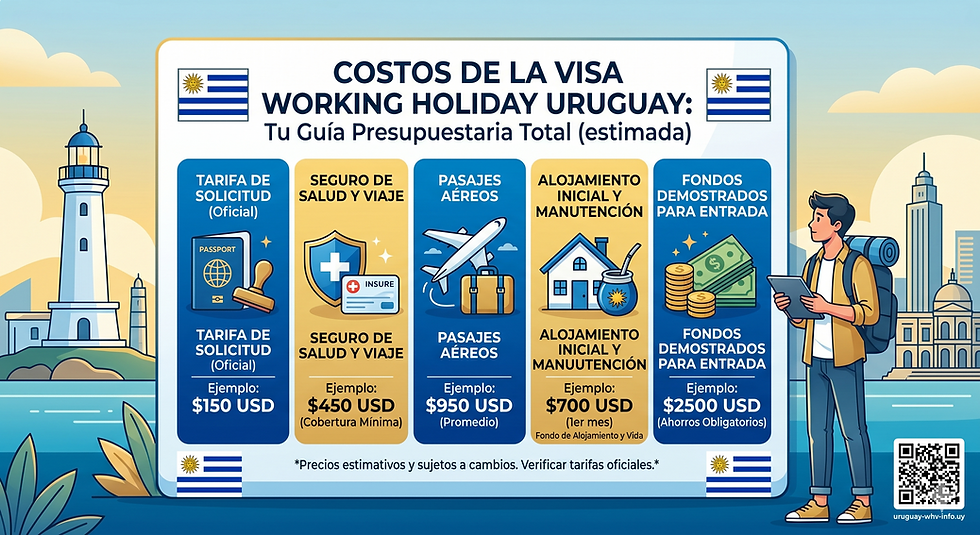
Step-by-Step Breakdown: From the Consulate to Residency
The financial commitment begins in the country of origin and culminates after arrival in the national territory. The amounts are divided as follows for all participating nationalities, including the recent agreement with the United Kingdom:
Consular Stage: The first payment is made to the Ministry of Foreign Affairs at the time of receiving the visa stamp in the passport. The approximate cost is USD 54, although it may vary slightly depending on the specific consulate.
Migration Stage in Uruguay: Once the traveler enters the country, they have a set period to formalize their Temporary Legal Residency. In this phase, two concepts must be paid to the National Directorate of Migration:
Residency Process: 557.30 UI
Migration Certificate: 55.70 UI
The Indexed Unit (UI) factor
It is essential for applicants to understand the functioning of the Indexed Unit (UI). The Uruguayan state uses this reference value for its administrative fees; the UI is readjusted daily based on inflation. Therefore, the final amount in Uruguayan pesos to be paid at the counter may fluctuate month to month. It is recommended to check the value of the day to ensure you have the exact cash or validated electronic payment methods.
Identification and Requirements for the Labor Market
Once residency is obtained, the young traveler must fully integrate into the national identification system. This involves two additional indispensable expenses:
Identity Card (Cedula): This is processed through the DNIC and has an approximate cost of $443 UYU (based on values current as of February 2026).
Occupational Health Card: For any Uruguayan company to formalize a work contract, it is mandatory to possess a valid local Health Card. The cost at authorized centers is approximately $1,480 UYU.
Critical External Expense Considerations
Beyond public fees, the travel budget must account for third-party services that are mandatory for file approval. The most significant item is public translation. Uruguay maintains a strict policy of documentary sovereignty: only translations performed by professionals registered with the Uruguayan Association of Public Translators are accepted. This requirement, added to the apostille of criminal records in the country of origin, represents an essential component of the total cost that should not be underestimated.
For personalized assistance and additional resources regarding your migration process, we invite you to visit our specialized section on the Working Holiday de Uruguay, where you will find tools designed to facilitate your integration into the country.


Comments