Document translation guide for the Working Holiday Uruguay Visa

Updated: May 16
Volare Editorial | May 15, 2026
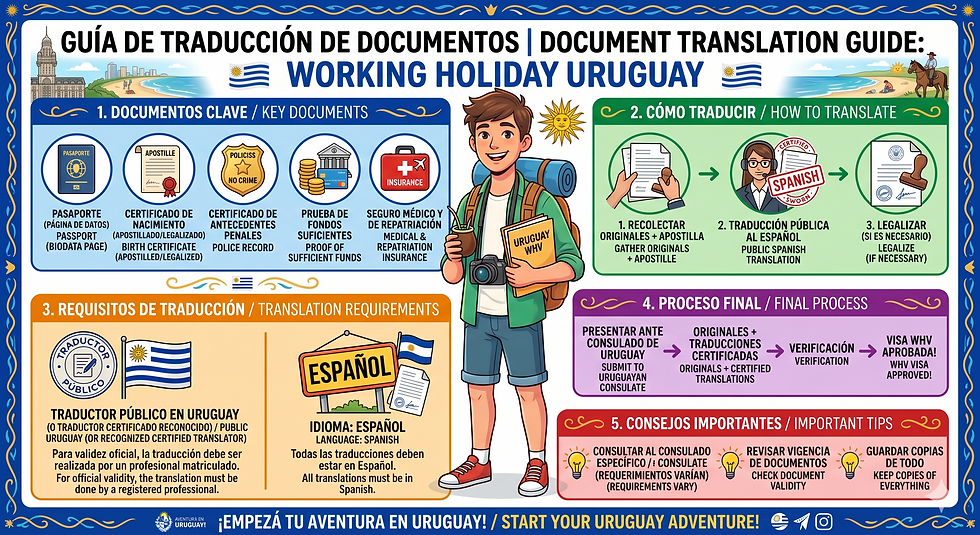
The validation of foreign documentation represents one of the most critical and often least understood steps of the Uruguayan migration process. Unlike other nations that admit documentation in lingua francas such as English, Uruguay maintains a strict policy of linguistic sovereignty. This principle requires that every public document not originally in Spanish must be translated into Castilian to possess legal effectiveness before national authorities.
The role of the Matriculated Public Translator
Uruguay does not recognize the validity of translations performed by professionals abroad, even if they have seals from sworn translators or notaries in cities such as Berlin, Paris, or Sydney. For a document to be admitted by the National Directorate of Migration or the National Directorate of Civil Identification, the translation must be performed within national territory.
The professional in charge must be a Public Translator matriculated and authorized by the Supreme Court of Justice. These experts, affiliated with the College of Public Translators of Uruguay (CTPU), are the only ones empowered to grant public faith to the translated version of birth certificates, criminal record certificates, or academic degrees.
The Certificate of Concordance
It is common for young people to arrive in the country with official translations already performed in their country of origin. In these cases, Uruguayan regulations prevent the direct submission of those pages. The applicant must hire a local translator to perform a "Certificate of Concordance."
This process involves the Uruguayan professional reviewing the foreign translation, verifying its fidelity with the original, and issuing a validation document that grants it legal status in the country. Due to the professional responsibility entailed in this review, the cost of this procedure is usually equivalent to that of a new translation.
The non-negotiable bureaucratic sequence
To avoid rejections in the file, it is imperative to follow a strict chronological order in the preparation of documents. A common error is translating a document before it has the necessary international validations. The correct order is:
Issuance: Obtaining the original document in the country of origin.
International Validation: Placement of the Hague Apostille (or consular legalization as appropriate).
Translation in Uruguay: The Uruguayan public translator can only intervene on documents that have already been duly apostilled.
This flow ensures that the translator's signature validates not only the content of the document but also the authenticity of the international certifications that accompany it.
For personalized assistance and additional resources regarding your migration process, we invite you to visit our specialized section on the Working Holiday de Uruguay, where you will find tools designed to facilitate your integration into the country.


Comments